Gravity of Grace Episode 6: God Does Not Abandon
To view a video version of this episode, click here
Have you ever made a massive mistake? Have you ever made a choice that you knew immediately was an extremely bad call? How did that make you feel?
When I was young, during a family gathering at my grandmother Olga’s childhood home, I made a terrible choice that had immediate consequences—just like Adam and Eve’s choice regarding the tree of the knowledge of good and evil.
We were in Giddings, Texas, on a beautiful day, and everyone was enjoying the pleasant weather. All the older cousins were playing outside nearer to one of the older barns when I came across two things that I should have left alone, an old piece of metal shaped like a lowercase “t” and a pile of cow manure. For reasons that only make sense to a boy about eight years old, I picked up the piece of metal and began poking the pile of partially dried manure. This, of course, caused a renewed burst of the unique aroma contained in fecal material as that end of the metal became covered in waste, and there was a hole in the center of the “cow pie.”
“Yuk!” The smell overpowered me, and I stepped a few paces away from the pile I had been digging in just to discover that I was bringing the smell with me on the metal still in my hand. To this day, I do not know what compelled me to throw this metal as far away as possible. But that is exactly what I tried to do.
However, I did not take a moment and look to see what things or people were “downrange”. I just threw the metal as if I could send it into orbit using a 45-degree angle throw. And only after releasing the metal and observing gravity defeat my limited force did I realize that my brother and four cousins stood in the arced path of my projectile.
I just froze, saying nothing and watching the consequences of my reckless decision play out on an innocent person. The metal fell back to the ground and struck my cousin in the head, cutting her pretty severely, and the moment she cried out, I felt a knot of guilt in the pit of my stomach tighten. Her pain was my fault and my fault alone.
As the adults ran towards her, my panic made it clear to everyone present just who had caused the injury to my family member. And she now needed both medical attention and sutures. The gravity of what I caused sank in on me as I witnessed the aftermath of my actions. In the end, I faced a well-deserved punishment for my actions. And after my cousin received the medical attention she needed; I apologized to her face-to-face while our parents watched to ensure that my words were both truthful and earnest.
There would be no escaping full accountability for what I and I alone had done through my irresponsible actions. And it is events like this that help me better understand what happened in the lives of my ancestors, Adam and Eve, that faithful day in the Garden of Eden.
I want to start our time together by reminding everyone that I make no claim to be an authority on the Scriptures. And in this episode, I am simply sharing the hope, encouragement, confidence, and expectation that I get from the stories shared in the biblical narrative. I am still a student, and I am daily striving to understand better as I meditate, study, and contemplate the things revealed in God’s word. The things I write and speak about are my personal testimony of faith, and I offer that testimony to encourage others to spend time in the Scriptures, allowing those writings to speak to them.
Shall we turn our attention to Genesis chapter 3?
And the woman said to the serpent, “We may eat of the fruit of the trees in the garden, but God said, ‘You shall not eat of the fruit of the tree that is in the midst of the garden, neither shall you touch it, lest you die.’” Genesis 3:2-3 (ESV)

To better understand this scene, I hope you will indulge me as I group the quotes from God and Eve into 3 separate categories.
First Category: Permission level on most trees.
Earlier in Genesis, we read God set a very welcoming policy when He declared the humans could “freely eat” or “eat, eat” from all the trees in the garden except for one. See Episode 5 “God’s Abundant Provision” for more details.
However, when Eve quoted this permission, she limited the allowance by stating, “may eat,” which is substantially less welcoming than “freely eat.”
To me, Eve’s quote changes the invitation from “have all you want” to “have a serving,” a difference that changes the nature of the host from extremely generous to polite. A significant downgrade in hospitality.
Second Category: Regarding the tree of knowledge of good and evil.
God had instructed the humans when He stated, “You shall not eat.”
Eve’s quote attaches an instruction God did not state, “You shall not eat, nor shall you touch.”
As I read the differences in the two quotes, I cannot help but see an elevation of the prohibition—making the “DO NOT” list larger than God made it. Which, to me, sounds like another way of downgrading the hospitality received by expanding what the guest cannot do.
Third Category: Consequences of not listening.
God stated, “You shall surely die.”
Eve, however, said, “Lest you die.”
A clear removal of the certainty of consequences. And in not holding to what God had actually told the humans, Eve, like many of us, set herself up for failure when her adversary came around and challenged her understanding of the hospitality, provision, and promises of God.
Eve subsequently believed the lie that was spoken to her that day by her enemy, which led her into actions she would later regret.
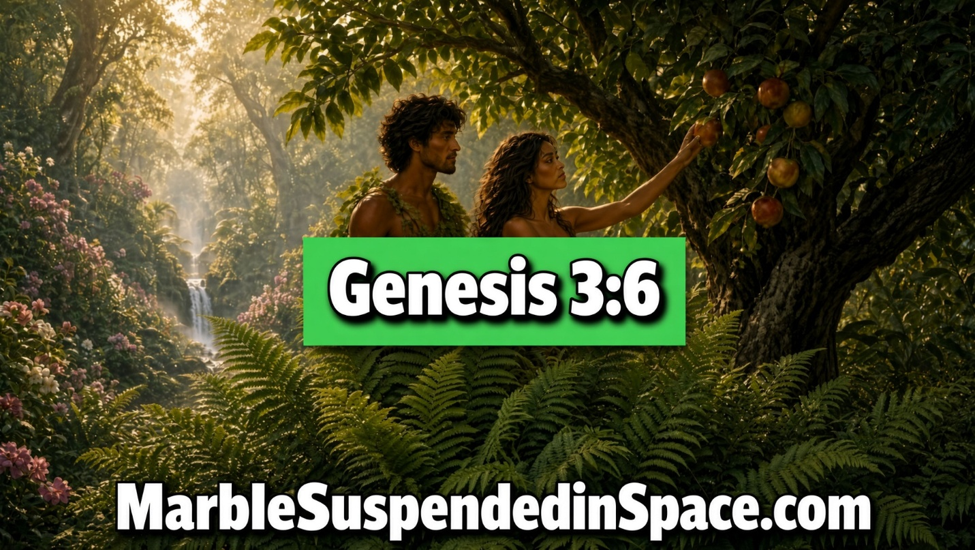
So when the woman saw that the tree was good for food, and that it was a delight to the eyes, and that the tree was to be desired to make one wise, she took of its fruit and ate, and she also gave some to her husband who was with her, and he ate. Genesis 3:6 (ESV)
And yes, I have used an image for this scene which interprets “who was with her” as Adam being right there when this all happened instead of being “with her” in the Garden, but not personally present when this event happened. This image reflects my conviction of what happened that day, but I was not there, so I freely admit that I may be wrong on Adam’s precise location. But this image also conveys the larger thought of both humans participating in the same action, even if for different reasons. They both failed to heed God’s wisdom, and they both suffered the consequences of that choice.
Which leads to a very well-known passage in Scripture: Genesis 3:7-8 from the ESV.
“Then the eyes of both were opened, and they knew that they were naked. And they sewed fig leaves together and made themselves loincloths. And they heard the sound of the Lord God walking in the garden in the cool of the day, and the man and his wife hid themselves from the presence of the Lord God among the trees of the garden.”
How frequently has the focus in this scene been on Adam and Eve’s effort to conceal themselves?
How often has that focus on the guilt of Adam and Eve overshadowed the fact that God came seeking them out? Just like the quoted words from our text in this image block a clear view of the One who is coming to be with Adam and Eve, although they are actively hiding from His presence.

But I have dedicated myself to using a good eye and thereby taking a more hopeful stance, which I find has changed how I see this event when I reflect upon it. This is a reference to Episode 1, “The Choice of Perspective,” and a reminder to always opt for the healthy perspective instead of the unhealthy perspective. I choose to look for the good in this scene before I focus on the bad so that I can complete the cycle and return to the good and thereby keep the bad from overwhelming me.
So let’s take another look at that same passage, looking for the source of light, hope, healing, and belonging so that the spaces of darkness, despair, pain, and isolation do not dominate our view.
I find tremendous hope because God cares enough to pursue the erring child, not to punish but to find and restore. In Genesis 3:9, God calls to Adam, “Where are you?” When I compare this question to all the other questions that God could have posed, I find its choice interesting and hope-inspiring.

I fully believe that God knew the answer to this question before He asked it. So, let us grapple with what is going on here. I believe that this interaction points to a benefit provided to humanity. Thus, I am convinced that when a human is honest with God about the situation the human’s choice has created, that said honesty seems to help the human in returning to a place of light, hope, healing, and belonging.
And yes, I have elected to use an image which evokes the idea of Jesus in His pre-incarnate form being the one who came to the Garden of Eden seeking Adam and Eve after the enemy’s successful attack on the relationship between humanity and Divinity.
I trust the first five verses of the Gospel of John and the rest of Scripture so much that when I read Genesis; I see Jesus.
Permit me to paraphrase John 1:1-5 now, and as always, I encourage you to read the text for yourself from whichever translation you trust.

So. Returning to our Genesis text. What do those differences between God’s command and Eve’s quote of God teach you about how to handle someone who is provoking you to reject God’s wisdom?
For me, this interaction encourages me to listen closely to God’s words, so that I can understand what He has to say without limiting His provision, adding to His prohibitions, or doubting His promises. Thus, this event recorded in Genesis provokes my desire to study the Scriptures so that I can hear God’s instructions, ponder the things I do not understand while listening for His guidance, and take comfort in the promises He has clearly communicated.
I have found that when I intentionally engage the Scriptures at any level from a surface-level reading to going deep into the overall narrative, God interacts with me on a personal level guiding me into wisdom, insights, and understandings which had previously eluded me.
Action Step: Think about, grapple with, and pray about how God does not abandon us even when we make horrible choices. In His lovingkindness: He seeks us out; He helps us to see how we have invited harm into our lives; and He enacts a plan to rescue, redeem, and restore. Truly, God is the same yesterday, today, and forever.
And Jesus (the God-man) maintains the same pattern in the New Testament that we saw in Genesis. Jesus perpetuates the pattern of: Seeking the lost, educating us on how we harm ourselves, and saving us from the spaces of darkness, despair, pain, and isolation.
Truly, Jesus is the good shepherd who seeks and saves those who get lost.
Glory be to God the Father and our Lord Jesus Christ!
Thank you for joining us on the Gravity of Grace podcast. I am Stephen C. Meade; I am your friend, and you can reach me at Stephen@marblesuspendedinspace.com
And I would love to hear from you. Until next time, goodbye and God bless!
Again, to view a video version of this episode, click here


Comments